



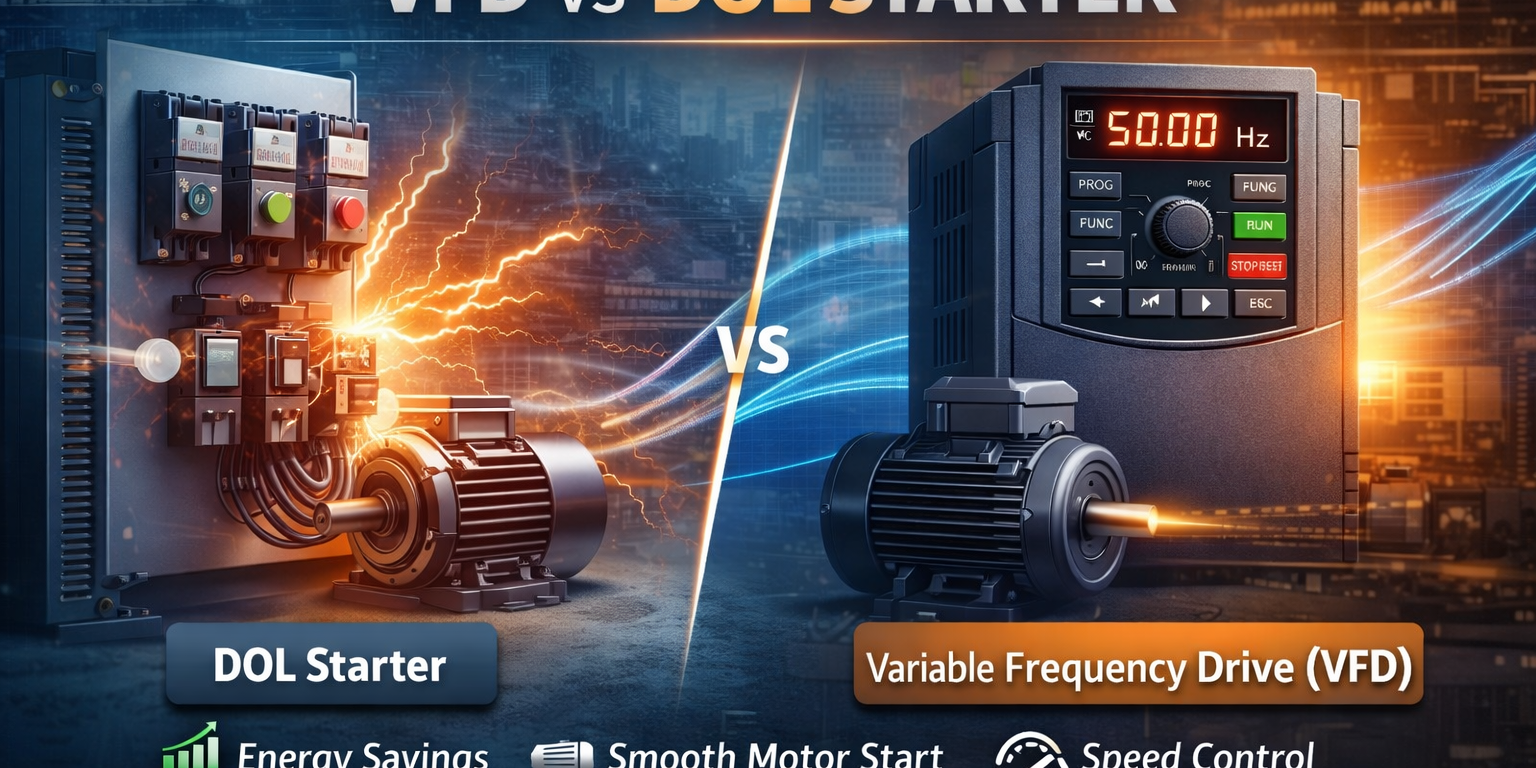
Selecting the right motor control method is critical for performance, energy efficiency, and equipment life. Two of the most commonly used solutions in industrial environments are the Variable Frequency Drive (VFD) and the Direct-On-Line (DOL) starter. While both are used to start and control motors, their working principles and applications are very different.
Understanding these differences helps in choosing the right solution for your plant or project.
What Is a DOL Starter?
A Direct-On-Line starter is the simplest and most traditional way to start an electric motor. It connects the motor directly to the power supply at full voltage.
When started, the motor immediately runs at its rated speed and draws a very high inrush current, typically 6 to 8 times the rated current.
Key characteristics of DOL starters:
-
Simple design
-
Low initial cost
-
Full voltage starting
-
No speed control
DOL starters are mainly used for small motors where starting current and mechanical stress are not a concern.
What Is a VFD?
A Variable Frequency Drive controls motor speed by varying the frequency and voltage supplied to the motor. Instead of starting abruptly, the motor accelerates smoothly from zero to the required speed.
VFDs allow complete control over motor speed, torque, and direction, making them ideal for modern automation systems.
Key Differences Between VFD and DOL Starter
Motor Starting
DOL starters start the motor instantly at full speed, causing mechanical shock.
VFDs provide soft start and soft stop, reducing stress on the motor and connected equipment.
Speed Control
DOL starters offer no speed control. The motor always runs at full speed.
VFDs allow precise speed control based on process requirements.
Energy Efficiency
DOL starters consume more energy in variable load applications.
VFDs reduce power consumption significantly, especially in pumps and fans.
Mechanical Wear
Sudden starting in DOL systems increases wear and tear.
VFDs reduce mechanical stress, increasing equipment life.
Initial Cost vs Operating Cost
DOL starters have a low upfront cost but higher long-term operating expenses.
VFDs have a higher initial cost but deliver long-term savings through energy efficiency and reduced maintenance.
Applications Where DOL Starters Are Suitable
-
Small motors
-
Constant speed applications
-
Simple machinery
-
Low-budget projects
-
Motors below a few HP where starting current is acceptable
Applications Where VFDs Are the Better Choice
-
Pumps and fans
-
Conveyors
-
Compressors
-
HVAC systems
-
Precision manufacturing equipment
-
Applications requiring energy savings and speed variation
Which One Should You Choose?
If your application requires only basic motor starting and cost is the main concern, a DOL starter may be sufficient. However, if energy efficiency, speed control, reduced maintenance, and process flexibility are important, a VFD is the better investment.
In modern industrial automation, VFDs are increasingly replacing traditional starters due to their long-term benefits and compatibility with PLC, HMI, and SCADA systems.
Conclusion
Both VFDs and DOL starters have their place in industrial motor control. The right choice depends on motor size, application type, load characteristics, and long-term operating goals.
At Avnika Electrosystems, we help industries select the most suitable motor control solution, whether it’s a basic starter or an advanced VFD-based automation system. Our team provides supply, integration, and technical support to ensure reliable and efficient operation.
